| Head to Tail method or graphical method is one of the easiest method used to find the resultant vector of two of more than two vectors. | ||
DETAILS OF METHOD
| ||
Consider two vectors  and  acting in the directions as shown below: | ||
 | ||
| In order to get their resultant vector by head to tail method we must follow the following steps: | ||
STEP # 1
| ||
| Choose a suitable scale for the vectors so that they can be plotted on the paper. | ||
STEP # 2
| ||
Draw representative line  of vector | ||
Draw representative line  of vector such that the tail of coincides with the head of vector . | ||
 | ||
STEP # 3
| ||
Join 'O' and 'B'. represents resultant vector of given vectors and i.e. | ||
 | ||
 | ||
STEP # 4
| ||
| Measure the length of line segment and multiply it with the scale choosen initially to get the magnitude of resultant vector. | ||
STEP # 5
| ||
| The direction of the resultant vector is directed from the tail of vector to the head of vector . | ||
Showing posts with label Conic Section. Show all posts
Showing posts with label Conic Section. Show all posts
Addition of vectors by Head to Tail method (Graphical Method)

MULTIPLICATION & DIVISION OF VECTOR BY A NUMBER (SCALAR)
MULTIPLICATION
OF A VECTOR BY A SCALAR | ||
| When a vector is multiplied by a positive number (for example 2, 3 ,5, 60 unit etc.) or a scalar only its magnitude is changed but its direction remains the same as that of the original vector. If however a vector is multiplied by a negative number (for example -2, -3 ,-5, -60 unit etc.) or a scalar not only its magnitude is changed but its direction also reversed. | ||
  | ||
The product of a vector  by a scalar quantity (m) follows the following rules: | ||
 (m) = (m) which is called commutative law of multiplication. | ||
| m(n) = (mn) which is called associative law of multiplication . | ||
| (m + n) = m+ n which is called distributive law of multiplication . | ||
DIVISION
OF A VECTOR BY A SCALAR | ||
| The division of a vector by a scalar number (n) involves the multiplication of the vector by the reciprocal of the number (n) which generates a new vector. | ||
| Let n represents a number or scalar and m is its reciprocal then the new vector is given by : | ||
where m = 1/n
 | ||
| and its magnitude is given by: | ||
 | ||
 The direction of is same as that of if (n) is a positive number. The direction of is opposite as that of if (n) is a negative number. | ||
Nomenclature of Simple Alkene Chain Molecules
Simple Alkene Chains
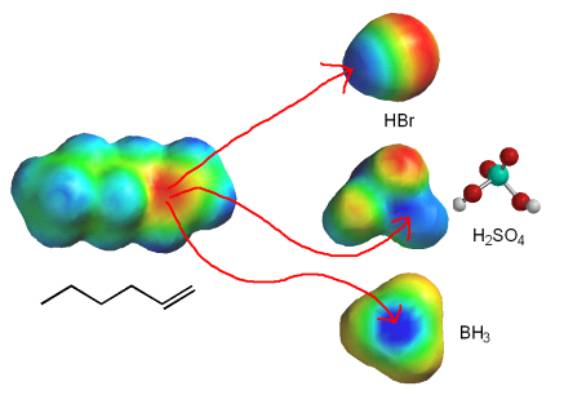 An alkene is a molecule made up entirely of carbon and hydrogen where on or more carbon atoms are connected by double bonds. The general formula for an alkene is CnH2n where n is the number of carbon atoms in the molecule.
Alkanes are named by adding the the -ene suffix to the prefix associated with the number of carbon atoms present in the molecule. A number and dash before the name denotes the number of the carbon atom in the chain that begins the double bond.
For example: 1-hexene is a six carbon chain where the double bond is between the first and second carbon atoms.
Click image to enlarge the molecule.
Ethene
Todd Helmenstine

Number of Carbons: 2
Prefix: eth- Number of Hydrogens: 2(2) = 4
Molecular Formula: C2H4
Prefix: eth- Number of Hydrogens: 2(2) = 4
Molecular Formula: C2H4
Hilfe und Informationen rund um den Radonschutz (Test ab 18 €).
Propene
Todd Helmenstine

Number of Carbons: 3
Prefix: prop- Number of Hydrogens: 2(3)= 6
Molecular Formula: C3H6
Prefix: prop- Number of Hydrogens: 2(3)= 6
Molecular Formula: C3H6
Butene
Todd Helmenstine

Number of Carbons: 4
Prefix: but- Number of Hydrogens: 2(4) = 8
Molecular Formula: C4H8
Prefix: but- Number of Hydrogens: 2(4) = 8
Molecular Formula: C4H8
Pentene
Todd Helmenstine

Number of Carbons: 5
Prefix: pent- Number of Hydrogens: 2(5) = 10
Molecular Formula: C5H10
Prefix: pent- Number of Hydrogens: 2(5) = 10
Molecular Formula: C5H10
Hexene
Todd Helmenstine

Number of Carbons: 6
Prefix: hex- Number of Hydrogens: 2(6)= 12
Molecular Formula: C6H12
Prefix: hex- Number of Hydrogens: 2(6)= 12
Molecular Formula: C6H12
Heptene
Todd Helmenstine

Number of Carbons: 7
Prefix: hept- Number of Hydrogens: 2(7) = 14
Molecular Formula: C7H14
Prefix: hept- Number of Hydrogens: 2(7) = 14
Molecular Formula: C7H14
Octene
Todd Helmenstine

Number of Carbons: 8
Prefix: oct- Number of Hydrogens: 2(8) = 16
Molecular Formula: C8H16
Prefix: oct- Number of Hydrogens: 2(8) = 16
Molecular Formula: C8H16
Nonene
Todd Helmenstine

Number of Carbons: 9
Prefix: non- Number of Hydrogens: 2(9) = 18
Molecular Formula: C9H18
Prefix: non- Number of Hydrogens: 2(9) = 18
Molecular Formula: C9H18
Decene
Todd Helmenstine

Number of Carbons: 10
Prefix: dec- Number of Hydrogens: 2(10) = 20
Molecular Formula: C10H20
Prefix: dec- Number of Hydrogens: 2(10) = 20
Molecular Formula: C10H20
Isomer Numbering Scheme

These three structures illustrate the numbering scheme for isomers of alkene chains. The carbon atoms are numbered from left to right. The number represents the location of the first carbon atom that is part of the double bond.
In this example: 1-hexene has the double bond between carbon 1 and carbon 2, 2-hexene between carbon 2 and 3, and 3-hexene between carbon 3 and carbon 4.
4-hexene is identical to 2-hexene and 5-hexene is identical to 1-hexene. In these cases, the carbon atoms would be numbered from right to left so the lowest number would be used to represent the molecule's name.
Subscribe to:
Posts (Atom)