SYMPTOMS
| |
| In HYPER METROPIA, a person can not see objects clearly which are near to him, but he can see clearly distant objects | |
REASON
| |
| The reason for HYPER METROPIA is that either the focal length of the lens of eye is too long or the eyeball is too short. | |
WHAT HAPPENS IN
HYPER METROPIA | |
| In HYPER METROPIA, light rays from a near object are focused behind the Retina. | |
 | |
CORRECTION OF DEFECT
| |
| This defect can be corrected by using a convex lens of suitable focal length | |
 | |
POWER OF LENS
| |
| Power of lens is defined as the reciprocal of the focal length of the lens in meters. | |
| FORMULA: | |
Power = 1/f(in meter)
| |
| Unit of power of lens is Dioptre. | |
DIOPTRE
| |
| Dioptre is defined as the power of lens whose focal length is one meter | |
| if f =1 meter then the power of the lens = 1 dioptre. | |
Showing posts with label Atomic.Molecular. Show all posts
Showing posts with label Atomic.Molecular. Show all posts
LONG SIGHTEDNESS OR HYPER METROPIA

STATES OF EQUILIBRIUM
States of equilibrium
| |
| There are three states of equilibrium: | |
 Stable equilibriumUnstable equilibriumNeutral equilibrium | |
Stable equilibrium
| |
| When the center of gravity of a body lies below point of suspension or support, the body is said to be in STABLE EQUILIBRIUM. For example a book lying on a table is in stable equilibrium. | |
Explanation
| |
| A book lying on a horizontal surface is an example of stable equilibrium. If the book is lifted from one edge and then allowed to fall, it will come back to its original position. Other examples of stable equilibrium are bodies lying on the floor such as chair, table etc. | |
Reason of stability
| |
| When the book is lifted its center of gravity is raised . The line of action of weight passes through the base of the book. A torque due to weight of the book brings it back to the original position. | |
 | |
| For latest information , free computer courses and high impact notes visit : | |
Unstable equilibrium
| |
| When the center of gravity of a body lies above the point of suspension or support, the body is said to be in unstable equilibrium | |
Example
| |
| pencil standing on its point or a stick in vertically standing position. | |
| Explanation: If thin rod standing vertically is slightly disturbed from its position it will not come back to its original position. This type of equilibrium is called unstable equilibrium, other example of unstable equilibrium are vertically standing cylinder and funnel etc. | |
Reason of instability
| |
| when the rod is slightly disturbed its center of gravity is lowered . The line of action of its weight lies outside the base of rod. The torque due to weight of the rod toppled it down. | |
 | |
Neutral equilibrium
| |
| When the center of gravity of a body lies at the point of suspension or support, the body is said to be in neutral equilibrium. Example: rolling ball. | |
Explanation
| |
| If a ball is pushed slightly to roll, it will neither come back to its original nor it will roll forward rather it will remain at rest. This type of equilibrium is called NEUTRAL EQUILIBRIUM. | |
Reason of neutral equilibrium
| |
| If the ball is rolled, its center of gravity is neither raised nor lowered. This means that its center of gravity is at the same height as before. | |
 | |
NEWTON'S 2ND LAW OF MOTION
When an unbalanced force acts upon a body, it is accelerated in the direction of force.
The magnitude of acceleration is directly proportional to the applied force and is inversely proportional to the mass of body. | |
| MATHEMATICALLY | |
 | |
| Combining (i) and (ii) | |
 .... | |
a = k (F)(1/m)
here constant k=1 | |
a= (1)(F)(1/m)
Or | |
 | |
SECOND STATEMENT
| |
| With the help of above equation 2nd law of motion can be expressed as: | |
THE NET FORCE ACTING ON A BODY IS EQUAL TO THE PRODUCT
OF THE MASS OF BODY AND THE ACCELERATION PRODUCED IN IT. | |
NEWTON'S 3RD LAW OF MOTION
| |
| STATEMENT: | |
"To every action there is a reaction equal in magnitude but opposite in direction"
| |
OR
| |
"When a body exerts a force on another body, the second body also exerts
a force on the first body of same magnitude but in the opposite direction" | |
FACTION = -FREACTION
| |
| Force exerted by one body is called ACTION and the force exerted by the second body is called REACTION. | |
| EXAMPLES: (1) Motion of rocket: fuel burns rapidly, exerts force in downward direction and rocket moves upward as a reaction. (2) Book lying on a table: weight of the book on the surface is action and the force exerted by the surface (R) is the reaction. R = -W (3) Walking on a street
(4) Motion of helicopter
| |
FORCE & MOTION
"Force is an agent which changes or tends to change the state
of rest or of uniform motion of a body."
| |
| In the light of Newton's 2nd law of motion Force may be defined as : | |
"Force acting on a body is equal to the product of the
mass and acceleration produced in the body."
| |
| i.e. | |
F = ma
| |
| Force can accelerate or decelerate a body. Force is a vector quantity. | |
UNITS OF FORCE
| |
| (i) NEWTON (N) in S.I system (ii) DYNE in C.G.S system (iii) POUND (Lb) in BRITISH ENGINEERING SYSTEM (F.P.S) | |
NEWTON
| |
| Newton is the unit of force and can be defined as: | |
"The amount of force that produces an acceleration of
1 m/s2 in a body of mass 1-kg is equal to 1 NEWTON." | |
1 N = 1 kg x 1m/s2
| |
[ N = kg m/s2]
| |
NEWTON 'S FIRST LAW OF MOTION
| |
| STATEMENT: Newton 's first law of motion states that: | |
"Every body remains at rest or continues to move with uniform
velocity in straight line unless an unbalanced force acts upon it". | |
EXPLANATION
| |
| First law of motion consists of two parts: | |
PART NO 1:
| |
| The first part states that a body at rest remains at rest unless an unbalanced force acts upon it. This part is in accordance with our common experience for example, a book lying on a table remains at rest unless it is lifted or pushed by an external force. | |
PART NO 2 :
| |
| Second part states that a body in motion remains in motion with uniform velocity unless an unbalance force acts upon it. This part is not self-evident because a ball pushed once does not continue its motion forever. A little consideration however, shows that there is an opposing force like ground friction and air friction acting in this case. These frictional forces are responsible to stop the ball. If we eliminate these opposing forces, a body in motion will continue its motion forever. | |
INERTIA
| |
"Tendency of a body by virtue of which the body at rest or
moving with uniform velocity retains its state is called INERTIA." | |
OR
| |
"Property of a body by which a body resists a force, applied to
it to change its state of rest or of uniform velocity is called INERTIA." | |
INERTIA of a body is directly related to its mass. Heavy bodies have greater inertia while lighter bodies have little inertia.
| |
LAW OF INERTIA AND THE
FIRST LAW OF MOTION | |
| Every body in the universe opposes the force which tends to change its state of rest or of uniform motion. This property INERTIA is a direct consequence of FIRST LAW OF MOTION. As heavy bodies due to greater INERTIA requires forces of large magnitude and bodies of small masses require small forces. By the above explanation of INERTIA we conclude that the state of rest or motion does not change by its self unless an external force acts upon it, which is according to the FIRST LAW OF MOTION. Thus the FIRST LAW OF MOTION is also called LAW OF INERTIA. | |
EQUATIONS OF MOTION EQUATIONS OF MOTION
FIRST EQUATION OF MOTION
Vf = Vi + at | ||
| Consider a body initial moving with velocity "Vi". After certain interval of time "t", its velocity becomes "Vf". Now | ||
Change in velocity = Vf - Vi
OR DV =Vf – Vi | ||
| Due to change in velocity, an acceleration "a" is produced in the body. Acceleration is given by | ||
a = DV/t
| ||
| Putting the value of "DV" | ||
a = (Vf – Vi)/t
at = Vf – Vi at + Vi =VfOR | ||
 | ||
SECOND EQUATION OF MOTION
OR S = Vit + 1/2at2 | ||
| Consider a car moving on a straight road with an initial velocity equal to ‘Vi’. After an interval of time ‘t’ its velocity becomes ‘Vf’. Now first we will determine the average velocity of body. | ||
Average velocity = (Initial velocity + final velocity)/2
OR Vav = (Vi + Vf)/2 | ||
| but Vf = Vi + at | ||
| Putting the value of Vf | ||
Vav = (Vi + Vi + at)/2
Vav = (2Vi + at)/2 Vav = 2Vi/2 + at/2 Vav = Vi + at/2 Vav = Vi + 1/2at.......................................(i) | ||
| we know that | ||
S = Vav x t
| ||
| Putting the value of ‘Vav’ | ||
S = [Vi + 1/2at] t
| ||
 | ||
THIRD EQUATION OF MOTION
OR 2aS = Vf2 – Vi2 | ||
| Initial velocity, final velocity, acceleration, and distance are related in third equation of motion. | ||
| Consider a body moving initially with velocity ‘Vi’. After certain interval of time its velocity becomes ‘Vf’. Due to change in velocity, acceleration ‘a’ is produced in the body. Let the body travels a distance of ‘s’ meters. According to first equation of motion: | ||
Vf = Vi + at
OR Vf – Vi = atOR (Vf – Vi)/a = t....................(i) | ||
| Average velocity of body is given by: | ||
Vav = (Initial velocity + Final velocity)/2
Vav = (Vi + Vf)/2.................. (ii) | ||
| we know that : | ||
S = Vav x t.................. (ii)
| ||
| Putting the value of Vav and t from equation (i) and (ii) in equation (iii) | ||
S = { (Vf + Vi)/2} { (Vf – Vi)/a}
2aS = (Vf + Vi)(Vf – Vi) | ||
| According to [ (a+b)(a-b)=a2-b2] | ||
 | ||
RESOLUTION OF VECTOR
DEFINITION
| ||
| The process of splitting a vector into various parts or components is called "RESOLUTION OF VECTOR" | ||
| These parts of a vector may act in different directions and are called "components of vector". | ||
| We can resolve a vector into a number of components .Generally there are three components of vector viz. Component along X-axis called x-component Component along Y-axis called Y-component Component along Z-axis called Z-component | ||
| Here we will discuss only two components x-component & Y-component which are perpendicular to each other.These components are called rectangular components of vector. | ||
METHOD OF RESOLVING
A VECTOR INTO RECTANGULAR COMPONENTS | ||
Consider a vector  acting at a point making an angle q with positive X-axis. Vector is represented by a line OA.From point A draw a perpendicular AB on X-axis.Suppose OB and BA represents two vectors.Vector OA is parallel to X-axis and vector BA is parallel to Y-axis.Magnitude of these vectors are Vx and Vy respectively.By the method of head to tail we notice that the sum of these vectors is equal to vector .Thus Vx and Vy are the rectangular components of vector .Vx = Horizontal component of .Vy = Vertical component of . | ||
 | ||
MAGNITUDE OF
HORIZONTAL COMPONENT | ||
| Consider right angled triangle DOAB | ||
 | ||
MAGNITUDE OF
VERTICAL COMPONENT | ||
| Consider right angled triangle DOAB | ||
 | ||
SCALARS & VECTORS
SCALAR QUANTITIES
| ||
Physical quantities which can completely be specified by a number (magnitude)
having an appropriate unit are known as "SCALAR QUANTITIES". | ||
| Scalar quantities do not need direction for their description. Scalar quantities are comparable only when they have the same physical dimensions. Two or more than two scalar quantities measured in the same system of units are equal if they have the same magnitude and sign. Scalar quantities are denoted by letters in ordinary type. Scalar quantities are added, subtracted, multiplied or divided by the simple rules of algebra. | ||
EXAMPLES
| ||
| Work, energy, electric flux, volume, refractive index, time, speed, electric potential, potential difference, viscosity, density, power, mass, distance, temperature, electric charge, electric flux etc. | ||
VECTORS QUANTITIES
| ||
Physical quantities having both magnitude and direction
with appropriate unit are known as "VECTOR QUANTITIES". | ||
| We can't specify a vector quantity without mention of deirection. vector quantities are expressed by using bold letters with arrow sign such as:  vector quantities can not be added, subtracted, multiplied or divided by the simple rules of algebra. vector quantities added, subtracted, multiplied or divided by the rules of trigonometry and geometry. | ||
EXAMPLES
| ||
| Velocity, electric field intensity, acceleration, force, momentum, torque, displacement, electric current, weight, angular momentum etc. | ||
REPRESENTATION OF VECTORS
| ||
| On paper vector quantities are represented by a straight line with arrow head pointing the direction of vector or terminal point of vector. | ||
| A vector quantity is first transformed into a suitable scale and then a line is drawn with the help of the | ||
| scale choosen in the given direction. | ||
 | ||
KINETIC ENERGY
KINETIC ENERGY
| KINETIC ENERGY | ||
"Energy posses by a body by virtue of its motion is referred to as ‘Kinetic Energy’".
| ||
| FORMULA | ||
K.E. = 1/2 mv2
| ||
| Kinetic energy depends upon the mass and velocity of body. If velocity is zero than K.E. of body will also be zero. | ||
| Kinetic energy is a scalar quantity like other forms of energies. | ||
| DERIVE: K.E = 1/2 mv2 | ||
PROOF
| ||
| Consider a body of mass "m" starts moving from rest. After a time interval "t" its velocity becomes V. If initial velocity of the body is Vi = 0 ,final velocity Vf = V and the displacement of body is "d". Then | ||
 | ||
| First of all we will find the acceleration of body. | ||
| Using equation of motion | ||
2aS = Vf2 – Vi2
Putting the above mentioned values 2ad = V2 – 0 a = V2/2d | ||
Now force is given by
F = ma Putting the value of accleration F = m(V2/2d) As we know that Work done = Fd | ||
Putting the value of F
Work done = (mv2/2d)(d) Work done = mV2/2 OR Work done = ½ mV2 | ||
Since the work done is motion is called "Kinetic Energy"
i.e. K.E. = Work done OR K.E. =1/2mV2. | ||
Organic Chemistry Introduction
What Organic Chemistry Is and What Organic Chemists
Organic chemistry is more than simply the study of carbon or the study of chemicals in living organisms. Take a look at what organic chemistry is, why it is important, and what organic chemists do.
 What Is Organic Chemistry?
Organic chemistry is the study of carbon and the study of the chemistry of life. Since not all carbon reactions are organic, another way to look at organic chemistry would be to consider it the study of molecules containing the carbon-hydrogen (C-H) bond and their reactions.
 Why Is Organic Chemistry Important?
Organic chemistry is important because it is the study of life and all of the chemical reactions related to life. Several careers apply an understanding of organic chemistry, such as doctors, veterinarians, dentists, pharmacologists, chemical engineers, and chemists. Organic chemistry plays a part in the development of common household chemicals, foods, plastics, drugs, fuels... really most of the chemicals part of daily life.
What Does an Organic Chemist Do?
An organic chemist is a chemist with a college degree in chemistry. Typically this would be a doctorate or master's degree in organic chemistry, though a bachelor's degree in chemistry may be sufficient for some entry level positions. Organic chemists usually conduct research and development in a laboratory setting. Projects that would use organic chemists would include development of a better painkilling drug, formulating a shampoo that would result in silkier hair, making a stain resistant carpet, or finding a non-toxic insect repellent.Nomenclature of Simple Alkene Chain Molecules
Simple Alkene Chains
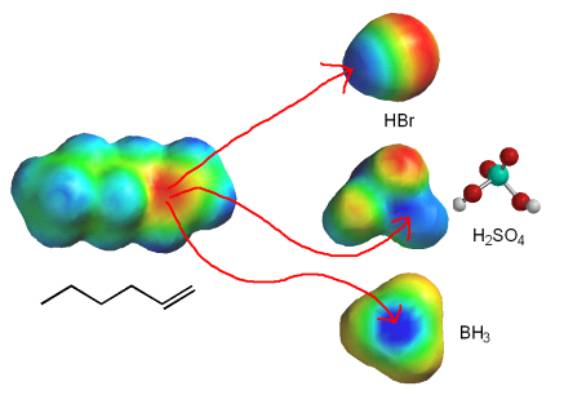 An alkene is a molecule made up entirely of carbon and hydrogen where on or more carbon atoms are connected by double bonds. The general formula for an alkene is CnH2n where n is the number of carbon atoms in the molecule.
Alkanes are named by adding the the -ene suffix to the prefix associated with the number of carbon atoms present in the molecule. A number and dash before the name denotes the number of the carbon atom in the chain that begins the double bond.
For example: 1-hexene is a six carbon chain where the double bond is between the first and second carbon atoms.
Click image to enlarge the molecule.
Ethene
Todd Helmenstine

Number of Carbons: 2
Prefix: eth- Number of Hydrogens: 2(2) = 4
Molecular Formula: C2H4
Prefix: eth- Number of Hydrogens: 2(2) = 4
Molecular Formula: C2H4
Hilfe und Informationen rund um den Radonschutz (Test ab 18 €).
Propene
Todd Helmenstine

Number of Carbons: 3
Prefix: prop- Number of Hydrogens: 2(3)= 6
Molecular Formula: C3H6
Prefix: prop- Number of Hydrogens: 2(3)= 6
Molecular Formula: C3H6
Butene
Todd Helmenstine

Number of Carbons: 4
Prefix: but- Number of Hydrogens: 2(4) = 8
Molecular Formula: C4H8
Prefix: but- Number of Hydrogens: 2(4) = 8
Molecular Formula: C4H8
Pentene
Todd Helmenstine

Number of Carbons: 5
Prefix: pent- Number of Hydrogens: 2(5) = 10
Molecular Formula: C5H10
Prefix: pent- Number of Hydrogens: 2(5) = 10
Molecular Formula: C5H10
Hexene
Todd Helmenstine

Number of Carbons: 6
Prefix: hex- Number of Hydrogens: 2(6)= 12
Molecular Formula: C6H12
Prefix: hex- Number of Hydrogens: 2(6)= 12
Molecular Formula: C6H12
Heptene
Todd Helmenstine

Number of Carbons: 7
Prefix: hept- Number of Hydrogens: 2(7) = 14
Molecular Formula: C7H14
Prefix: hept- Number of Hydrogens: 2(7) = 14
Molecular Formula: C7H14
Octene
Todd Helmenstine

Number of Carbons: 8
Prefix: oct- Number of Hydrogens: 2(8) = 16
Molecular Formula: C8H16
Prefix: oct- Number of Hydrogens: 2(8) = 16
Molecular Formula: C8H16
Nonene
Todd Helmenstine

Number of Carbons: 9
Prefix: non- Number of Hydrogens: 2(9) = 18
Molecular Formula: C9H18
Prefix: non- Number of Hydrogens: 2(9) = 18
Molecular Formula: C9H18
Decene
Todd Helmenstine

Number of Carbons: 10
Prefix: dec- Number of Hydrogens: 2(10) = 20
Molecular Formula: C10H20
Prefix: dec- Number of Hydrogens: 2(10) = 20
Molecular Formula: C10H20
Isomer Numbering Scheme

These three structures illustrate the numbering scheme for isomers of alkene chains. The carbon atoms are numbered from left to right. The number represents the location of the first carbon atom that is part of the double bond.
In this example: 1-hexene has the double bond between carbon 1 and carbon 2, 2-hexene between carbon 2 and 3, and 3-hexene between carbon 3 and carbon 4.
4-hexene is identical to 2-hexene and 5-hexene is identical to 1-hexene. In these cases, the carbon atoms would be numbered from right to left so the lowest number would be used to represent the molecule's name.

How To Name Compounds - Chemistry Nomenclature
Chemistry Notes and Review
.
How To Name Compounds - Chemistry Nomenclature.
n order for chemists and other scientists to communicate with each other, a system of nomenclature or naming was agreed upon by the International Union of Pure and Applied Chemistry or IUPAC. You'll hear chemicals called their common names (e.g., salt, sugar, and baking soda), but in the lab you would use systematic names (e.g., sodium chloride, sucrose, and sodium bicarbonate). Here's a review of some key points about nomenclature.
Naming Ionic Compounds
Naming Binary Compounds
Compounds may be made up of only two elements (binary compounds) or more than two elements. Certain rules apply when naming binary compounds:- If one of the elements is a metal, it is named first.
- Some metals can form more than one positive ion. It is common to state the charge on the ion using Roman numerals. For example, FeCl2 is iron(II) chloride.
- If the second element is a nonmetal, the name of the compound is the metal name followed by a stem (abbreviation) of the nonmetal name followed by "ide". For example, NaCl is named sodium chloride.
- For compounds consisting of two nonmetals, the more electropositive element is named first. The stem of the second element is named, followed by "ide". An example is HCl, which is hydrogen chloride.
Naming Ionic Compounds
In addition to the rules for naming binary compounds, there are additional naming conventions for ionic compounds:
- Some polyatomic anions contain oxygen. If an element forms two oxyanions, the one with less oxygen ends in -ite while the one with more oxgyen ends in -ate. For example:
NO2- is nitrite
NO3- is nitrate

Chemical Bonds and Bonding
Chemistry Notes and Review

This is a review of notes on chemical bonds and bonding at the high school or 11th grade chemistry level. Chemical bonds are easy to understand if you keep in mind the following properties of atoms and electrons:
- Atoms seek the most stable configuration.
- The Octet Rule states that atoms with 8 electrons in their outer orbital will be most stable.
- Atoms can share, give, or take electrons of other atoms. These are forms of chemical bonds.
- Bonds occur between the valence electrons of atoms, not the inner electrons.
Types of Chemical Bonds
The two main types of chemical bonds are ionic and covalent bonds, but you should be aware of several forms of bonding:- Ionic Bonds
Ionic bonds form when one atom takes an electron from another atom.Example: NaCl is formed by an ionic bond where sodium donates its valence electron to chlorine. Chlorine is a halogen. All halogens have 7 valence electrons and need one more to gain a stable octet. Sodium is an alkali metal. All alkali metals have 1 valence electron, which they readily donate to form a bond. - Covalent Bonds
Covalent bonds form when atoms share electrons. Really, the main difference is the electrons in ionic bonds are more closely associated with one atomic nucleus or the other, which electrons in a covalent bonds are about equally likely to orbit one nucleus as the other. If the electron is more closely associated with one atom than the other, a polar covalent bond may form.Example: Covalent bonds form between hydrogen and oxygen in water, H2O. - Metallic Bond
When the two atoms both are metals, a metallic bond forms. The difference in a metal is that the electrons could be around any metal atom, not just two atoms in a compound.Example: Metallic bonds are seen in samples of pure elemental metals, such as gold or aluminum, or alloys, such as brass or bronze.
Ionic or Covalent?
You may be wondering how you can tell whether a bond is ionic or covalent. You can look at the placement of elements on the periodic table or a table of element electronegativities to predict the type of bond that will form. If the electronegativity values are very different from each other, an ionic bond will form. Usually the cation is a metal and the anion is a nonmetal. If the elements both are metals, expect a metallic bond to form. If the electronegativity values are similar, expect a covalent bond to form. Bonds between two nonmetals are covalent bonds. Polar covalent bonds form between elements that have intermediate differences between the electronegativity values. Usually on a test, you'll be given clear examples of ionic compounds or covalent compounds or you'll need to pick the molecule most likely to form polar covalent bonds from a list.
Periodic Table Notes and Review

Periodic Table Notes and Review

The periodic table is an important tool in chemistry. These notes review the periodic table, how it is organized, and periodic table trends.
Invention and Organization of the Periodic Table
In 1869, Dmitri Mendeleev organized the chemical elements into a periodic table much like the one we use today, except his elements were ordered according to increasing atomic weight, while the modern table is organized by increasing atomic number. The way the elements are organized makes it possible to see trends in element properties and to predict the behavior of elements in chemical reactions.
Rows (moving left to right) are called periods. Elements in a period share the same highest energy level for an unexcited electron. There are more sublevels per energy level as atom size increases, so there are more elements in periods further down the table.
Columns (moving top to bottom) form the basis for element groups. Elements in groups share the same number of valence electrons or outer electron shell arrangement, which gives elements in a group several common properties. Examples of element groups are alkali metals and noble gases.
Periodic Table Trends or Periodicity
The organization of the periodic table makes it possible to see trends in properties of elements at a glance. The important trends relate to atomic radius, ionization energy, electronegativity, and electron affinity.
- Atomic Radius
Atomic radius reflects the size of an atom. Atomic radius decreases moving from left to right across a period and increases moving from top to bottom down an element group. Although you might think atoms would simply become larger as they gain more electrons, electrons remain in a shell, while the increasing number of protons pulls the shells in closer to the nucleus. Moving down a group, electrons are found further from the nucleus in new energy shells, so the overall size of the atom increases. - Ionization Energy
Ionization energy is the amount of energy needed to remove an electron from an ion or atom in the gas state. Ionization energy increases moving from left to right across a period and decreases moving top to bottom down a group. - Electronegativity
Electronegativity is a measure of how easily an atom forms a chemical bond. The higher the electronegativity, the higher the attraction for bonding an electron. Electronegativitydecreases moving down an element group. Elements on the lefthand side of the periodic table tend to be electropositive or more likely to donate an electron than accept one. - Electron Affinity
Electron affinity reflects how readily an atom will accept an electron. Electron affinity varies according to element group. The noble gases have electron affinities near zero because they have filled electron shells. The halogens have high electron affinities because the addition of an electron gives an atom a completely filled electron shell.

Subscribe to:
Posts (Atom)