Newton’s corpuscular theory of light
| |
| Newton’s corpuscular theory of light is based on the following points 1. Light consists of very tiny particles known as “corpuscular”. 2. These corpuscles on emission from the source of light travel in straight line with high velocity 3. When these particles enter the eyes, they produce image of the object or sensation of vision. 4. Corpuscles of different colours have different sizes. | |
Huygen’s wave theory of light
| |
| In 1679, Christian Huygens proposed the wave theory of light. According to huygen’s wave theory: 1. Each point in a source of light sends out waves in all directions in hypothetical medium called "ETHER". 2. Light is a form of energy 3. Light travels in the form of waves. 4. A medium is necessary for the propagation of waves & the whole space is filled with an imaginary medium called Ether 5. Light waves have very short wave length | |
Quantum theory of light
| |
| Quantum theory was put forward by MAX-PLANCK in 1905. According to quantum theory “Energy radiated or absorbed can not have any fractional value. This energy must be an integral multiple of a fixed quantity of energy. This quantity is called “QUANTUM” OR Energy released or absorbed is always in the form of packets of energy or bundles of energy. These packets of energy are known as QUANTA or PHOTONS | |
Showing posts with label Alkene Chain. Show all posts
Showing posts with label Alkene Chain. Show all posts
NATURE OF LIGHT

SIMPLE PENDULUM
| SIMPLE PENDULUM | ||
| simple pendulum consists of a heavy mass particle suspended by a light, flexible and in-extensible string. | ||
| MOTION OF THE BOB OF SIMPLE PENDULUM | ||
| The motion of the bob of simple pendulum simple harmonic motion if it is given small displacement. In order to prove this fact consider a simple pendulum having a bob of mass 'm' and the length of pendulum is 'l'. Assuming that the mass of the string os pendulum is negligible. When the pendulum is at rest at position 'A', the only force acting is its weight and tension in the string. When it is displaced from its mean position to another new position say 'B' and released, it vibrates to and fro around its mean position. | ||
| Suppose that at this instant the bob is at point 'B' as shown below : | ||
| FORCES ACTING ON THE BOB | ||
| 1. Weight of the bob (W) acting vertically downward. 2. Tension in the string (T) acting along the string. | ||
| The weight of the bob can be resolved into two rectangular components: | ||
| a. Wcosq along the string. b. Wsinq perpendicular to string. | ||
| Since there is no motion along the string, therefore, the component Wcosq must balance tension (T) i.e. Wcosq = T | ||
| This shows that only Wsinq is the net force which is responsible for the acceleration in the bob of pendulum. | ||
| According to Newton's second law of motion Wsinq will be equal to m x a | ||
| i.e. Wsinq = m a | ||
| Since Wsinq is towards the mean position, therefore, it must have a negative sign. i.e. m a = - Wsinq | ||
| But W = mg | ||
| m a = - mgsinq | ||
| a = - gsinq | ||
| In our assumption q is very small because displacement is small, in this condition we can take sinq = q | ||
| Hence a = - gq ----------- (1) | ||
| If x be the linear displacement of the bob from its mean position, then from figure, the length of arc AB is nearly equal to x | ||
| From elementary geometry we know that: | ||
 | ||
| Where s= x, r = l | ||
| Putting the value of q in equation (1) | ||
 | ||
| As the acceleration of the bob of simple pendulum is directly proportional to displacement and is directed towards the mean position, therefore the motion of the bob is simple harmonic when it is given a small displacement | ||
THERMAL CONDUCTIVITY
THERMAL CONDUCTIVITY
| |
| Thermal conductivity is defined as" the amount of heat conducted in one second through one cubic meter of a substance whose two opposite faces are maintained at the temperature difference of one degree centigrade." It is denoted by "K". Formula K=QL/ADTt Unit : Unit of thermal conductivity is J/mKs OR watt/m.K. | |
EXPRESSION FOR
THERMAL CONDUCTIVITY |  |
Experiments indicates that the amount of heat conducted through a solid block is : Directly proportional to temperature difference between two faces of block. Directly proportional to temperature difference between two faces of block. | |
DQ a DT ...................... (i)
| |
| Directly proportional to the area of cross - section of block. | |
DQ a A ...................... (ii)
| |
| Directly proportional to the the time interval to which heat is conducted. | |
DQ a t ...................... (iii)
| |
| Inversly proportional to the length of block. | |
DQ a 1/L ...................... (iv)
| |
| Combining above facts,we get | |
DQ a DT.A.t /L
| |
| OR | |
 | |
| OR | |
 | |
Momentum- Law of conservation of Momentum
MOMENTUM
| |
| Quantity of motion of a body is referred to as "MOMENTUM". | |
Definition
| |
| Momentum of a moving body defined as : | |
"the product of mass and velocity of a body is called MOMENTUM."
| |
| Mathematically | |
Momentum = mass x velocity
| |
 | |
| It is a vector quantity. Momentum is always directed in the direction of velocity. The unit of momentum is in S.I system kg .m/s or NS. Momentum depends upon mass and velocity of body. | |
LAW OF CONSERVATION OF MOMENTUM.
| |
| The law of conservation of momentum states that: | |
"when some bodies constituting an isolated system act upon
one another, the total momentum of the system remains constant."
OR
"the total momentum of an isolated system of interacting bodies remains constant."
OR "Total momentum of an isolated system before collision is always equal to total momentum after collision." | |
| Consider an isolated system of two bodies 'A' and 'B' as shown. The masses of bodies are ma and mb and | |
MATHEMATICAL REPRESENTATION
| |
| Consider two bodies of mass m1 and m2 moving initially with velocities u1 and u2. | |
 | |
| Total momentum before collision = m1u1 + m2u2 | |
 | |
| Let after collision their velocities become v1 and v2. | |
 | |
| Total momentum after collision = m1v1 + m2v2 | |
| According to the law of conservation of momentum | |
m1u1 + m2u2 = m1v1 + m2v2
| |
ADDITION OF VECTORS
ADDITION OF VECTORS4
PARALLELOGRAM LAW OF VECTOR ADDITION
| ||
| Acccording to the parallelogram law of vector addition: | ||
"If two vector quantities are represented by two adjacent sides or a parallelogram
then the diagonal of parallelogram will be equal to the resultant of these two vectors." | ||
EXPLANATION
| ||
Consider two vectors  . Let the vectors have the following orientation . Let the vectors have the following orientation | ||
 | ||
| parallelogram of these vectors is : | ||
 | ||
| According to parallelogram law: | ||
 | ||
MAGNITUDE OF
RESULTANT VECTOR | ||
| Magintude or resultant vector can be determined by using either sine law or cosine law. | ||
 | ||
 | ||
SCALARS & VECTORS
SCALAR QUANTITIES
| ||
Physical quantities which can completely be specified by a number (magnitude)
having an appropriate unit are known as "SCALAR QUANTITIES". | ||
| Scalar quantities do not need direction for their description. Scalar quantities are comparable only when they have the same physical dimensions. Two or more than two scalar quantities measured in the same system of units are equal if they have the same magnitude and sign. Scalar quantities are denoted by letters in ordinary type. Scalar quantities are added, subtracted, multiplied or divided by the simple rules of algebra. | ||
EXAMPLES
| ||
| Work, energy, electric flux, volume, refractive index, time, speed, electric potential, potential difference, viscosity, density, power, mass, distance, temperature, electric charge, electric flux etc. | ||
VECTORS QUANTITIES
| ||
Physical quantities having both magnitude and direction
with appropriate unit are known as "VECTOR QUANTITIES". | ||
| We can't specify a vector quantity without mention of deirection. vector quantities are expressed by using bold letters with arrow sign such as:  vector quantities can not be added, subtracted, multiplied or divided by the simple rules of algebra. vector quantities added, subtracted, multiplied or divided by the rules of trigonometry and geometry. | ||
EXAMPLES
| ||
| Velocity, electric field intensity, acceleration, force, momentum, torque, displacement, electric current, weight, angular momentum etc. | ||
REPRESENTATION OF VECTORS
| ||
| On paper vector quantities are represented by a straight line with arrow head pointing the direction of vector or terminal point of vector. | ||
| A vector quantity is first transformed into a suitable scale and then a line is drawn with the help of the | ||
| scale choosen in the given direction. | ||
 | ||
LAW OF CONSERVATION OF ENERGY
LAW OF CONSERVATION OF ENERGY
| ||
| According to the law of conservation of energy : "Energy can neither be created nor it is destroyed, however energy can be converted from one form energy to any other form of energy" | ||
| SHOW THAT THE MOTION OF A SIMPLE PENDULUM IS ACCORDING TO THE LAW OF CONSERVATION ENERGY. OR PROVE THE LAW OF CONSERVATION WITH THE HELP OF A SUITABLE EXAMPLE. | ||
| We know that the motion of the bob of a simple pendulum is simple harmonic motion. Here we have to prove that the energy is conversed during the motion of pendulum. Proof: Consider a simple pendulum as shown in the diagram. | ||
 | ||
Energy Conservation At Point ‘A’
| ||
| At point ‘A’ velocity of the bob of simple pendulum is zero. Therefore, K.E. at point ‘A’ = 0. Since the bob is at a height (h), Therefore, P.E. of the bob will be maximum. i.e. P.E. = mgh. Energy total = K.E. + P.E Energy total = 0 + mgh Energy total = mgh This shows that at point A total energy is potential energy. | ||
Energy Conservation At Point ‘M’
| ||
| If we release the bob of pendulum from point ‘A’, velocity of bob gradually increases, but the height of bob will decreases from point to the point. At point ‘M’ velocity will become maximum and the height will be nearly equal to zero. Thus , K.E. = maximum = 1/2mV2 but P.E. = 0. Energy total = K.E. + P.E Energy total = 1/2mV2 + 0 Energy total = 1/2mV2 This shows that the P.E. at point is completely converted into K.E. at point ‘M’. | ||
Energy Conservation At Point ‘B’
| ||
| At point M the bob of Pendulum will not stop but due to inertia, the bob will moves toward the point ‘B’. As the bob moves from ‘M’ to ‘B’, its velocity gradually decreases but the height increases. At point ‘B’ velocity of the bob will become zero. Thus K.E. at point ‘B’ = 0 but P.E. = max. P.E. = mgh. Energy total = K.E. + P.E. Energy total = 0 + mgh Energy total = mgh This shows that at point B total energy is again potential energy. | ||
CONCLUSION
| ||
| Above analysis indicates that the total energy during the motion does not change. I.e. the motion of the bob of simple pendulum is according to the law of conservation of energy. | ||
Nomenclature of Simple Alkene Chain Molecules
Simple Alkene Chains
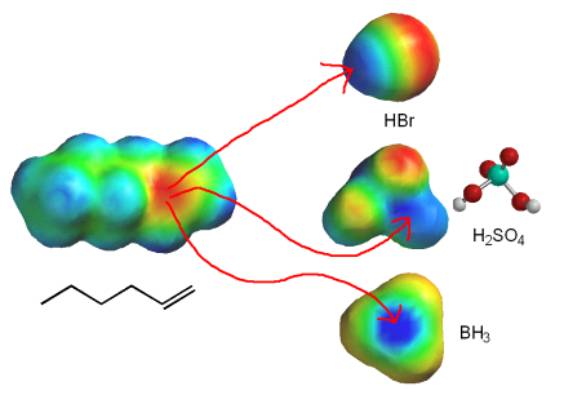 An alkene is a molecule made up entirely of carbon and hydrogen where on or more carbon atoms are connected by double bonds. The general formula for an alkene is CnH2n where n is the number of carbon atoms in the molecule.
Alkanes are named by adding the the -ene suffix to the prefix associated with the number of carbon atoms present in the molecule. A number and dash before the name denotes the number of the carbon atom in the chain that begins the double bond.
For example: 1-hexene is a six carbon chain where the double bond is between the first and second carbon atoms.
Click image to enlarge the molecule.
Ethene
Todd Helmenstine

Number of Carbons: 2
Prefix: eth- Number of Hydrogens: 2(2) = 4
Molecular Formula: C2H4
Prefix: eth- Number of Hydrogens: 2(2) = 4
Molecular Formula: C2H4
Hilfe und Informationen rund um den Radonschutz (Test ab 18 €).
Propene
Todd Helmenstine

Number of Carbons: 3
Prefix: prop- Number of Hydrogens: 2(3)= 6
Molecular Formula: C3H6
Prefix: prop- Number of Hydrogens: 2(3)= 6
Molecular Formula: C3H6
Butene
Todd Helmenstine

Number of Carbons: 4
Prefix: but- Number of Hydrogens: 2(4) = 8
Molecular Formula: C4H8
Prefix: but- Number of Hydrogens: 2(4) = 8
Molecular Formula: C4H8
Pentene
Todd Helmenstine

Number of Carbons: 5
Prefix: pent- Number of Hydrogens: 2(5) = 10
Molecular Formula: C5H10
Prefix: pent- Number of Hydrogens: 2(5) = 10
Molecular Formula: C5H10
Hexene
Todd Helmenstine

Number of Carbons: 6
Prefix: hex- Number of Hydrogens: 2(6)= 12
Molecular Formula: C6H12
Prefix: hex- Number of Hydrogens: 2(6)= 12
Molecular Formula: C6H12
Heptene
Todd Helmenstine

Number of Carbons: 7
Prefix: hept- Number of Hydrogens: 2(7) = 14
Molecular Formula: C7H14
Prefix: hept- Number of Hydrogens: 2(7) = 14
Molecular Formula: C7H14
Octene
Todd Helmenstine

Number of Carbons: 8
Prefix: oct- Number of Hydrogens: 2(8) = 16
Molecular Formula: C8H16
Prefix: oct- Number of Hydrogens: 2(8) = 16
Molecular Formula: C8H16
Nonene
Todd Helmenstine

Number of Carbons: 9
Prefix: non- Number of Hydrogens: 2(9) = 18
Molecular Formula: C9H18
Prefix: non- Number of Hydrogens: 2(9) = 18
Molecular Formula: C9H18
Decene
Todd Helmenstine

Number of Carbons: 10
Prefix: dec- Number of Hydrogens: 2(10) = 20
Molecular Formula: C10H20
Prefix: dec- Number of Hydrogens: 2(10) = 20
Molecular Formula: C10H20
Isomer Numbering Scheme

These three structures illustrate the numbering scheme for isomers of alkene chains. The carbon atoms are numbered from left to right. The number represents the location of the first carbon atom that is part of the double bond.
In this example: 1-hexene has the double bond between carbon 1 and carbon 2, 2-hexene between carbon 2 and 3, and 3-hexene between carbon 3 and carbon 4.
4-hexene is identical to 2-hexene and 5-hexene is identical to 1-hexene. In these cases, the carbon atoms would be numbered from right to left so the lowest number would be used to represent the molecule's name.
In this example: 1-hexene has the double bond between carbon 1 and carbon 2, 2-hexene between carbon 2 and 3, and 3-hexene between carbon 3 and carbon 4.
4-hexene is identical to 2-hexene and 5-hexene is identical to 1-hexene. In these cases, the carbon atoms would be numbered from right to left so the lowest number would be used to represent the molecule's name.
Subscribe to:
Posts (Atom)