COMMUTATIVE LAW
OF VECTOR ADDITION | ||
Consider two vectors  and  . Let these two vectors represent two adjacent sides of a parallelogram. We construct a parallelogram | ||
OACB as shown in the diagram. The diagonal OC represents the resultant vector  | ||
 | ||
| From above figure it is clear that: | ||
| This fact is referred to as the commutative law of vectr addition . | ||
ASSOCIATIVE LAW
OF VECTOR ADDITION | ||
| The law states that the sum of vectors remains same irrespective of their order or grouping in which they are arranged. Consider three vectors , and  | ||
| Applying "head to tail rule" to obtain the resultant of (+ ) and (+ ) | ||
| Then finally again find the resultant of these three vectors : | ||
 | ||
| This fact is known as the ASSOCIATIVE LAW OF VECTOR ADDITION. | ||
Showing posts with label Alkanes. Show all posts
Showing posts with label Alkanes. Show all posts
AREA OF PARALLELOGRAM

EQUATIONS OF MOTION EQUATIONS OF MOTION
FIRST EQUATION OF MOTION
Vf = Vi + at | ||
| Consider a body initial moving with velocity "Vi". After certain interval of time "t", its velocity becomes "Vf". Now | ||
Change in velocity = Vf - Vi
OR DV =Vf – Vi | ||
| Due to change in velocity, an acceleration "a" is produced in the body. Acceleration is given by | ||
a = DV/t
| ||
| Putting the value of "DV" | ||
a = (Vf – Vi)/t
at = Vf – Vi at + Vi =VfOR | ||
 | ||
SECOND EQUATION OF MOTION
OR S = Vit + 1/2at2 | ||
| Consider a car moving on a straight road with an initial velocity equal to ‘Vi’. After an interval of time ‘t’ its velocity becomes ‘Vf’. Now first we will determine the average velocity of body. | ||
Average velocity = (Initial velocity + final velocity)/2
OR Vav = (Vi + Vf)/2 | ||
| but Vf = Vi + at | ||
| Putting the value of Vf | ||
Vav = (Vi + Vi + at)/2
Vav = (2Vi + at)/2 Vav = 2Vi/2 + at/2 Vav = Vi + at/2 Vav = Vi + 1/2at.......................................(i) | ||
| we know that | ||
S = Vav x t
| ||
| Putting the value of ‘Vav’ | ||
S = [Vi + 1/2at] t
| ||
 | ||
THIRD EQUATION OF MOTION
OR 2aS = Vf2 – Vi2 | ||
| Initial velocity, final velocity, acceleration, and distance are related in third equation of motion. | ||
| Consider a body moving initially with velocity ‘Vi’. After certain interval of time its velocity becomes ‘Vf’. Due to change in velocity, acceleration ‘a’ is produced in the body. Let the body travels a distance of ‘s’ meters. According to first equation of motion: | ||
Vf = Vi + at
OR Vf – Vi = atOR (Vf – Vi)/a = t....................(i) | ||
| Average velocity of body is given by: | ||
Vav = (Initial velocity + Final velocity)/2
Vav = (Vi + Vf)/2.................. (ii) | ||
| we know that : | ||
S = Vav x t.................. (ii)
| ||
| Putting the value of Vav and t from equation (i) and (ii) in equation (iii) | ||
S = { (Vf + Vi)/2} { (Vf – Vi)/a}
2aS = (Vf + Vi)(Vf – Vi) | ||
| According to [ (a+b)(a-b)=a2-b2] | ||
 | ||
Addition of vectors by Head to Tail method (Graphical Method)
| Head to Tail method or graphical method is one of the easiest method used to find the resultant vector of two of more than two vectors. | ||
DETAILS OF METHOD
| ||
Consider two vectors  and  acting in the directions as shown below: | ||
 | ||
| In order to get their resultant vector by head to tail method we must follow the following steps: | ||
STEP # 1
| ||
| Choose a suitable scale for the vectors so that they can be plotted on the paper. | ||
STEP # 2
| ||
Draw representative line  of vector | ||
Draw representative line  of vector such that the tail of coincides with the head of vector . | ||
 | ||
STEP # 3
| ||
Join 'O' and 'B'. represents resultant vector of given vectors and i.e. | ||
 | ||
 | ||
STEP # 4
| ||
| Measure the length of line segment and multiply it with the scale choosen initially to get the magnitude of resultant vector. | ||
STEP # 5
| ||
| The direction of the resultant vector is directed from the tail of vector to the head of vector . | ||
KINETIC ENERGY
KINETIC ENERGY
| KINETIC ENERGY | ||
"Energy posses by a body by virtue of its motion is referred to as ‘Kinetic Energy’".
| ||
| FORMULA | ||
K.E. = 1/2 mv2
| ||
| Kinetic energy depends upon the mass and velocity of body. If velocity is zero than K.E. of body will also be zero. | ||
| Kinetic energy is a scalar quantity like other forms of energies. | ||
| DERIVE: K.E = 1/2 mv2 | ||
PROOF
| ||
| Consider a body of mass "m" starts moving from rest. After a time interval "t" its velocity becomes V. If initial velocity of the body is Vi = 0 ,final velocity Vf = V and the displacement of body is "d". Then | ||
 | ||
| First of all we will find the acceleration of body. | ||
| Using equation of motion | ||
2aS = Vf2 – Vi2
Putting the above mentioned values 2ad = V2 – 0 a = V2/2d | ||
Now force is given by
F = ma Putting the value of accleration F = m(V2/2d) As we know that Work done = Fd | ||
Putting the value of F
Work done = (mv2/2d)(d) Work done = mV2/2 OR Work done = ½ mV2 | ||
Since the work done is motion is called "Kinetic Energy"
i.e. K.E. = Work done OR K.E. =1/2mV2. | ||
ENERGY
ENERGY
| ||
| "The ability of a body to perform work is called Energy". | ||
| A body cannot perform work if it does not posses energy.A body cannot perform work more than the amount of energy. | ||
| It is a scalar quantity. | ||
UNITS OF ENERGY
| ||
| (i) Joule (ii) Calorie [NOTE: 1 Calorie = 4.2 joule.] (iii) KWatt-Hour | ||
TYPES OF ENERGY
| ||
There aree numerous types of energy such as: Heat Energy Light Energy Sound Energy Nuclear Energy Chemical Energy Electrical Energy Solar Energy Wind Energy Kinetic Energy Potential Energy etc. etc. | ||
POWER
| ||
"The rate of work done of a body is called Power".
| ||
AVERAGE POWER
| ||
| Average power of a body doing work is numerically equal to the totla work done divided by the time taken to perform the work. | ||
MATHMATICALLY
| ||
Power = Work done/time
Power = Work/t but [work = Fd] therefore Power = Fd/t | ||
UNITS OF POWER
| ||
| (i) watt [1 watt = 1joule/sec ] (ii) Kilo watt [1Kw = 1000 watt] (iii) Mega watt (Mw) [1Mw = 106 watt] (iv) Horse power [1Hp = 746w] | ||
| POTENTIAL ENERGY | ||
INTRODUCTION
| ||
| Energy stored by a body by any means is called "Potential Energy". | ||
DEFINITION
| ||
| "The energy stored by a body due to its position in gravitational field is known as ‘Gravitational Potential Energy’". | ||
FORMULA
| ||
| Consider a body of mass "m" placed at a height of "h" from the surface of earth. Force = Weight = W but displacement (d) = h | ||
 | ||
Work done = Fd
OR Work done = Wh [but W = mg] | ||
| work done = mgh WE know that the work done in lifting the body is stored in the body in the form of Potential Energy. Thus P.E. = mgh | ||
Alkane Nomenclature & Numbering
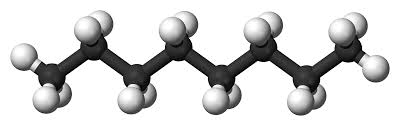 Alkane Nomenclature & Numbering
The simplest organic compounds are hydrocarbons. Hydrocarbons contain only two elements, hydrogen and carbon. A saturated hydrocarbon or alkane is a hydrocarbon in which all of the carbon-carbon bonds are single bonds. Each carbon atom forms four bonds and each hydrogen forms a single bond to a carbon. The bonding around each carbon atom is tetrahedral, so all bond angles are 109.5°. As a result, the carbon atoms in higher alkanes are arranged in zig-zag rather than linear patterns.
Straight Chain Alkanes
The general formula for an alkane is CnH2n+2 wheren is the number of carbon atoms in the molecule. There are two ways of writing a condensed structural formula. For example, butane may be written as CH3CH2CH2CH3 or CH3(CH2)2CH3.
Rules for Naming Alkanes
- The parent name of the molecule is determined by the number of carbons in the longest chain.
- In the case where two chains have the same number of carbons, the parent is the chain with the most substituents.
- The carbons in the chain are numbered starting from the end nearest the first substituent.
- In the case where there are substituents having the same number of carbons from both ends, numbering starts from the end nearest the next substituent.
- When more than one of a given substituent is present, a prefix is applied to indicate the number of substituents. Use di- for two, tri- for three, tetra- for four, etc. and use the number assigned to the carbon to indicate the position of each substituent.
Branched Alkanes
- Branched substituents are numbered starting from the carbon of the substituent attached to the parent chain. From this carbon, count the number of carbons in the longest chain of the substituent. The substituent is named as an alkyl group based on the number of carbons in this chain.
- Numbering of the substituent chain starts from the carbon attached to the parent chain.
- The entire name of the branched substituent is placed in parentheses, preceded by a number indicating which parent-chain carbon it joins.
- Substituents are listed in alphabetical order. To alphabetize, ignore numerical (di-, tri-, tetra-) prefixes (e.g., ethyl would come before dimethyl), but don't ignore don't ignore positional prefixes such as iso and tert (e.g., triethyl comes before tertbutyl).
Cyclic Alkanes
- The parent name is determined by the number of carbons in the largest ring (e.g., cycloalkane such as cyclohexane).
- In the case where the ring is attached to a chain containing additional carbons, the ring is considered to be a substituent on the chain. A substituted ring that is a substituent on something else is named using the rules for branched alkanes.
- When two rings are attached to each other, the larger ring is the parent and the smaller is a cycloalkyl substituent.
- The carbons of the ring are numbered such that the substituents are given the lowest possible numbers.
Straight Chain Alkanes
| # Carbon | Name | Molecular Formula | Structural Formula |
| 1 | Methane | CH4 | CH4 |
| 2 | Ethane | C2H6 | CH3CH3 |
| 3 | Propane | C3H8 | CH3CH2CH3 |
| 4 | Butane | C4H10 | CH3CH2CH2CH3 |
| 5 | Pentane | C5H12 | CH3CH2CH2CH2CH3 |
| 6 | Hexane | C6H14 | CH3(CH2)4CH3 |
| 7 | Heptane | C7H16 | CH3(CH2)5CH3 |
| 8 | Octane | C8H18 | CH3(CH2)6CH3 |
| 9 | Nonane | C9H20 | CH3(CH2)7CH3 |
| 10 | Decane | C10H22 | CH3(CH2)8CH3 |
Subscribe to:
Posts (Atom)