REFLECTION OF LIGHT
| |
| When light rays traveling is a medium reaches the boundary of other medium, they turn back to the first medium. This phenomenon of turning back of light into the same medium after striking the boundary of other medium is called Reflection of Light. | |
 | |
LAWS OF REFLECTION
| |
| 1. The angle of incident is equal to the angle of reflection i.e. <i = <r 2. The incident ray, the reflected ray and the normal lie on the same plane. | |
REGULAR REFLECTION
| |
| When a beam pass of parallel light rays is incident on a smooth and plane surface, the reflected rays will also be parallel. This type of reflection is called Regular Reflection. | |
 | |
IRREGULAR REFLECTION
| |
| When a beam of parallel light rays is scattered in all directions. Therefore the parallel rays incident on the surface will reflect in different directions. This type of reflection is called "Irregular or Diffuse Reflection". | |
 | |
CENTER OF CURVATURE
| |
| Center of curvature of a lens or mirror is defined as the center of the sphere of which the less or mirror is a part. C = Center of curvature. | |
 | |
RADIUS OF CURVATURE
| |
| Radius of curvature is the radius of sphere of which the lens or mirror is a part. | |
PC = Radius of curvature
OR PC = R | |
 | |
POLE
| |
| For latest information , free computer courses and high impact notes | |
| The middle or center point of a lens or a mirror is called "Pole" P = Pole. | |
PRINCIPLE AXIS
| |
| The straight line joining the center of curvature to the pole is called Principle Axis. . | |
 | |
PRINCIPLE FOCUS
| |
| When a narrow beam of light, parallel to the principle axis and closed to it, is incident on the surface of a mirror or lens, the beam reflected or refracted is converged at a fixed point on the axis. This point is called Principle Axis. F = principle focus. | |
 | |
FOCAL LENGTH
| |
| The distance between the pole of a lens or mirror to the principal focus is called Focal Length (PF) of lens or mirror. Focal length is always equal to half of the radius of curvature of lens or mirror. f = R/2. | |
| Write down the characteristics of image formed by a plane mirror | |
| 1. Image formed by plane mirror is laterally inverted. This means that right side of the object appears on the left side. 2. Size of image formed by plane mirror is the same as that of size of object. 3. The image formed by plane mirror is virtual because it can not be obtained on the screen. 4. The image is as far behind the mirror as the object is in front of the mirror. Fig. | |
DEFINE SPHERICAL MIRROR
AND IT'S TWO TYPES | |
SPHERICAL MIRROR
| |
| Mirror obtained from a spherical surface is known as Spherical Mirror. A spherical mirror is considered as a section of hollow sphere. | |
 | |
TYPES OF SPHERICAL MIRRORS
| |
| There are two types of spherical mirrors. 1. Concave mirror. 2. Convex mirror. | |
CONCAVE MIRROR
| |
| If the inner side of the surface of a spherical mirror is polished to reflect light, the mirror is called a Concave Mirror. Concave mirror converges parallel beam of light. | |
 | |
CONVEX MIRROR
| |
| If the outer side of the surface of a spherical mirror is polished to reflect light the mirror is called a Convex Mirror. Convex mirror diverges parallel beam light. | |
| |
MAGNIFICATION
| |
| Magnification of a mirror or lens is defined as the ratio of the size of image to the size of object. | |
M = height of image/height of object
M = hi/ho or M = q/P | |
REFRACTIVE INDEX
| |
| Refractive index is defined as the ratio of sine of the angle of incidence of the sine of the angle of refraction. FORMULA : | |
m= sine< i/ sine< r
| |
| note :Refractive index depends upon the nature of material. It has no unit. | |
ANGLE OF DEVIATION
| |
| The angle at which the light ray is refracted (bend) in a prism is called angle of deviation. It is denoted by < D. Minimum value of angle of deviation is called angle of minimum deviation. It is denoted by <Dm. | |
Showing posts with label Notes. Show all posts
Showing posts with label Notes. Show all posts
REFLECTION OF LIGHT DEFINITIONS

THERMAL CONDUCTIVITY
THERMAL CONDUCTIVITY
| |
| Thermal conductivity is defined as" the amount of heat conducted in one second through one cubic meter of a substance whose two opposite faces are maintained at the temperature difference of one degree centigrade." It is denoted by "K". Formula K=QL/ADTt Unit : Unit of thermal conductivity is J/mKs OR watt/m.K. | |
EXPRESSION FOR
THERMAL CONDUCTIVITY |  |
Experiments indicates that the amount of heat conducted through a solid block is : Directly proportional to temperature difference between two faces of block. | |
DQ a DT ...................... (i)
| |
| Directly proportional to the area of cross - section of block. | |
DQ a A ...................... (ii)
| |
| Directly proportional to the the time interval to which heat is conducted. | |
DQ a t ...................... (iii)
| |
| Inversly proportional to the length of block. | |
DQ a 1/L ...................... (iv)
| |
| Combining above facts,we get | |
DQ a DT.A.t /L
| |
| OR | |
 | |
| OR | |
 | |
DIFFERENCE BETWEEN MASS AND WEIGHT
Mass
|
Weight
| |
| (1) The quantity of matter in a body is called its mass. | (1) Weight is the force by which the earth attracts a body towards its center. | |
| (2) Mass is a scalar quantity. | (2) Weight is a vector quantity and is always directed towards the center of the earth. | |
| (3) Mass of a body is always constant every where in the universe. | (3) Weight of a body vary place to place and become zero on the center of earth and far away from the surface of earth. | |
| (4) Mass of a moving body is m=F/a. | (4) Weight of a body is W = mg. | |
| (5) Mass can be determine by an ordinary balance. | (5) Weight of a body is measured by spring balance. | |
| (6) Unit of mass in S.I system is KILOGRAM ( kg). | (6) Unit of weight in S.I system is NEWTON (N). | |
FRICTION
| ||
| When a body slides over the surface of another body, an opposing force is set up between them to resist the motion. The force which opposes the motion is called friction OR Force of Friction. | ||
| Force of friction tends to decelerate a body and always acts in the opposite direction of motion. | ||
| CATEGORIES OF FRICTION (1) Contact friction (2) Fluid friction | ||
LIMITING FRICTION
| ||
| When an external force is applied against the force of friction, the force of friction also increases by the same amount. Therefore, It adjusts itself in such a way that it is equal and opposite to the external force. It has a maximum value just before the motion starts. So friction is a self-adjusting force. The maximum force of friction that stops the body from moving is called LIMITING FRICTION. It is denoted by Fs. LIMITING FRICTION is directly proportional to the surface reaction. | ||
| Limiting friction Fs is: | ||
 Where R = normal reaction but R = W and R = mg  | ||
Where  = constant known as coefficient of friction. | ||
COEFFICIENT OF FRICTION
| ||
| Coefficient of friction is the ratio of LIMITING FRICTION to the NORMAL REACTION. | ||
 | ||
| Coefficient of friction is constant for a given pair of surfaces but different for different pairs | ||
| Unit of : Since it is a ratio of two similar quantities, therefore it has no unit as shown. | ||
ROLLING FRICTION
|
www.citycollegiate.com
| |
| When a body rolls over a surface, the force of friction is called ROLLING FRICTION. When a sphere rolls over a surface it experiences an opposing force called ROLLING FRICTION. Rolling friction is much less than the sliding friction because in case of rolling contact area of two surfaces is very small as compared to sliding. | ||
AREA OF PARALLELOGRAM
COMMUTATIVE LAW
OF VECTOR ADDITION | ||
Consider two vectors  and  . Let these two vectors represent two adjacent sides of a parallelogram. We construct a parallelogram | ||
OACB as shown in the diagram. The diagonal OC represents the resultant vector  | ||
 | ||
| From above figure it is clear that: | ||
| This fact is referred to as the commutative law of vectr addition . | ||
ASSOCIATIVE LAW
OF VECTOR ADDITION | ||
| The law states that the sum of vectors remains same irrespective of their order or grouping in which they are arranged. Consider three vectors , and  | ||
| Applying "head to tail rule" to obtain the resultant of (+ ) and (+ ) | ||
| Then finally again find the resultant of these three vectors : | ||
 | ||
| This fact is known as the ASSOCIATIVE LAW OF VECTOR ADDITION. | ||
LAW OF CONSERVATION OF ENERGY
LAW OF CONSERVATION OF ENERGY
| ||
| According to the law of conservation of energy : "Energy can neither be created nor it is destroyed, however energy can be converted from one form energy to any other form of energy" | ||
| SHOW THAT THE MOTION OF A SIMPLE PENDULUM IS ACCORDING TO THE LAW OF CONSERVATION ENERGY. OR PROVE THE LAW OF CONSERVATION WITH THE HELP OF A SUITABLE EXAMPLE. | ||
| We know that the motion of the bob of a simple pendulum is simple harmonic motion. Here we have to prove that the energy is conversed during the motion of pendulum. Proof: Consider a simple pendulum as shown in the diagram. | ||
 | ||
Energy Conservation At Point ‘A’
| ||
| At point ‘A’ velocity of the bob of simple pendulum is zero. Therefore, K.E. at point ‘A’ = 0. Since the bob is at a height (h), Therefore, P.E. of the bob will be maximum. i.e. P.E. = mgh. Energy total = K.E. + P.E Energy total = 0 + mgh Energy total = mgh This shows that at point A total energy is potential energy. | ||
Energy Conservation At Point ‘M’
| ||
| If we release the bob of pendulum from point ‘A’, velocity of bob gradually increases, but the height of bob will decreases from point to the point. At point ‘M’ velocity will become maximum and the height will be nearly equal to zero. Thus , K.E. = maximum = 1/2mV2 but P.E. = 0. Energy total = K.E. + P.E Energy total = 1/2mV2 + 0 Energy total = 1/2mV2 This shows that the P.E. at point is completely converted into K.E. at point ‘M’. | ||
Energy Conservation At Point ‘B’
| ||
| At point M the bob of Pendulum will not stop but due to inertia, the bob will moves toward the point ‘B’. As the bob moves from ‘M’ to ‘B’, its velocity gradually decreases but the height increases. At point ‘B’ velocity of the bob will become zero. Thus K.E. at point ‘B’ = 0 but P.E. = max. P.E. = mgh. Energy total = K.E. + P.E. Energy total = 0 + mgh Energy total = mgh This shows that at point B total energy is again potential energy. | ||
CONCLUSION
| ||
| Above analysis indicates that the total energy during the motion does not change. I.e. the motion of the bob of simple pendulum is according to the law of conservation of energy. | ||
Alkane Nomenclature & Numbering
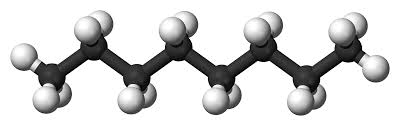 Alkane Nomenclature & Numbering
The simplest organic compounds are hydrocarbons. Hydrocarbons contain only two elements, hydrogen and carbon. A saturated hydrocarbon or alkane is a hydrocarbon in which all of the carbon-carbon bonds are single bonds. Each carbon atom forms four bonds and each hydrogen forms a single bond to a carbon. The bonding around each carbon atom is tetrahedral, so all bond angles are 109.5°. As a result, the carbon atoms in higher alkanes are arranged in zig-zag rather than linear patterns.
Straight Chain Alkanes
The general formula for an alkane is CnH2n+2 wheren is the number of carbon atoms in the molecule. There are two ways of writing a condensed structural formula. For example, butane may be written as CH3CH2CH2CH3 or CH3(CH2)2CH3.
Rules for Naming Alkanes
- The parent name of the molecule is determined by the number of carbons in the longest chain.
- In the case where two chains have the same number of carbons, the parent is the chain with the most substituents.
- The carbons in the chain are numbered starting from the end nearest the first substituent.
- In the case where there are substituents having the same number of carbons from both ends, numbering starts from the end nearest the next substituent.
- When more than one of a given substituent is present, a prefix is applied to indicate the number of substituents. Use di- for two, tri- for three, tetra- for four, etc. and use the number assigned to the carbon to indicate the position of each substituent.
Branched Alkanes
- Branched substituents are numbered starting from the carbon of the substituent attached to the parent chain. From this carbon, count the number of carbons in the longest chain of the substituent. The substituent is named as an alkyl group based on the number of carbons in this chain.
- Numbering of the substituent chain starts from the carbon attached to the parent chain.
- The entire name of the branched substituent is placed in parentheses, preceded by a number indicating which parent-chain carbon it joins.
- Substituents are listed in alphabetical order. To alphabetize, ignore numerical (di-, tri-, tetra-) prefixes (e.g., ethyl would come before dimethyl), but don't ignore don't ignore positional prefixes such as iso and tert (e.g., triethyl comes before tertbutyl).
Cyclic Alkanes
- The parent name is determined by the number of carbons in the largest ring (e.g., cycloalkane such as cyclohexane).
- In the case where the ring is attached to a chain containing additional carbons, the ring is considered to be a substituent on the chain. A substituted ring that is a substituent on something else is named using the rules for branched alkanes.
- When two rings are attached to each other, the larger ring is the parent and the smaller is a cycloalkyl substituent.
- The carbons of the ring are numbered such that the substituents are given the lowest possible numbers.
Straight Chain Alkanes
| # Carbon | Name | Molecular Formula | Structural Formula |
| 1 | Methane | CH4 | CH4 |
| 2 | Ethane | C2H6 | CH3CH3 |
| 3 | Propane | C3H8 | CH3CH2CH3 |
| 4 | Butane | C4H10 | CH3CH2CH2CH3 |
| 5 | Pentane | C5H12 | CH3CH2CH2CH2CH3 |
| 6 | Hexane | C6H14 | CH3(CH2)4CH3 |
| 7 | Heptane | C7H16 | CH3(CH2)5CH3 |
| 8 | Octane | C8H18 | CH3(CH2)6CH3 |
| 9 | Nonane | C9H20 | CH3(CH2)7CH3 |
| 10 | Decane | C10H22 | CH3(CH2)8CH3 |

How To Name Compounds - Chemistry Nomenclature
Chemistry Notes and Review
.
How To Name Compounds - Chemistry Nomenclature.
n order for chemists and other scientists to communicate with each other, a system of nomenclature or naming was agreed upon by the International Union of Pure and Applied Chemistry or IUPAC. You'll hear chemicals called their common names (e.g., salt, sugar, and baking soda), but in the lab you would use systematic names (e.g., sodium chloride, sucrose, and sodium bicarbonate). Here's a review of some key points about nomenclature.
Naming Ionic Compounds
Naming Binary Compounds
Compounds may be made up of only two elements (binary compounds) or more than two elements. Certain rules apply when naming binary compounds:- If one of the elements is a metal, it is named first.
- Some metals can form more than one positive ion. It is common to state the charge on the ion using Roman numerals. For example, FeCl2 is iron(II) chloride.
- If the second element is a nonmetal, the name of the compound is the metal name followed by a stem (abbreviation) of the nonmetal name followed by "ide". For example, NaCl is named sodium chloride.
- For compounds consisting of two nonmetals, the more electropositive element is named first. The stem of the second element is named, followed by "ide". An example is HCl, which is hydrogen chloride.
Naming Ionic Compounds
In addition to the rules for naming binary compounds, there are additional naming conventions for ionic compounds:
- Some polyatomic anions contain oxygen. If an element forms two oxyanions, the one with less oxygen ends in -ite while the one with more oxgyen ends in -ate. For example:
NO2- is nitrite
NO3- is nitrate

Trigonometric Functions and their Graphs - Maths
Chapter 11: Trigonometric Functions and their Graphs

Notes (Solutions) of Chapter 11: Trigonometric Functions and their Graphs, Text Book of Algebra and Trigonometry Class XI (Mathematics FSc Part 1 or HSSC-I), Punjab Text Book Board, Lahore.
Contents & summary
- Introduction
- Domains and Ranges of Sine and Cosine Functions
- Domains and Ranges of Tangent and Cotangent Functions
- Domain and Range of Secant Function
- Domain and Range of Cosecant Function
- Period of Trigonometric Functions
- Exercise 11.1
- Values of Trigonometric Functions
- Graphs of Trigonometric Functions
- Graph of
y=sinx from−2π to 2π - Graph of
y=cosx from−2π to 2π - Graph of
y=tanx from−π to π - Graph of
y=cotx from−2π to π - Graph of
y=secx from−2π to 2π - Graph of
y=cscx from−2π to 2π - Exercise 11.2
Subscribe to:
Posts (Atom)